

From organic waste to fertile soil.
A new model for organic waste management. Immediate, in continuous cycle, without methane emissions, leachate or odour.
Biocatalysis module in operation · La Aldea de San Nicolás de Tolentino
Biactro redefines how organic waste is managed.
Biactro develops end-to-end projects for the management and valorisation of organic waste at source. Every tonne creates two streams of value: the treatment service and a premium agronomic product.
Burning, landfilling, composting and digesting all rest on the same assumption: that organic matter needs time to stabilise. Biocatalysis removes that time, and with it the stockpiling that produces odours, leachate and methane.
The difference happens on three levels at once.
Time
With no wait there is no stockpiling, and with no stockpiling there is no surface area occupied, no odours, pests, leachate or methane.
The contaminant load
Pathogens, plant protection product residues, antibiotics and unwanted vegetation seeds are removed, so the material is applied without sanitary risk or cross-contamination.
The product
Integral 1:1 recovery: the input mass is recovered across the valuable solid and liquid output fractions. The solid fraction is Class A soil improver, calibrated to the crop.
Time explains the environmental impact. The product explains the value. Biactro changes both.
Four steps, one single flow.
The natural mechanism of digestion, reproduced in accelerated and controlled form, in a closed circuit and at ambient temperature.
Shredding
Reduction to the particle size that allows the process to act at molecular level.
Sanitisation
Removes pathogens, insect eggs and unwanted vegetation seeds, and breaks down plant protection products, antibiotics and pesticides.
Stabilisation
Completes maturation. The material will not ferment again or generate odours, and can be stored or transported without degrading.
Enrichment
Incorporates selected beneficial microbiota and concentrates the humic fraction, which sustains long-term fertility.
The architecture is modular: capacity is added by placing modules in parallel. It accepts every kind of pure organic waste, including manure and slurry, agri-food by-products, pruning residues, digestate and compost the market does not absorb.
One product, two destinations.
A homogeneous particulate material, fine-grained and earthy brown in colour, with the smell of damp soil. It can be picked up by hand and applied the same day.
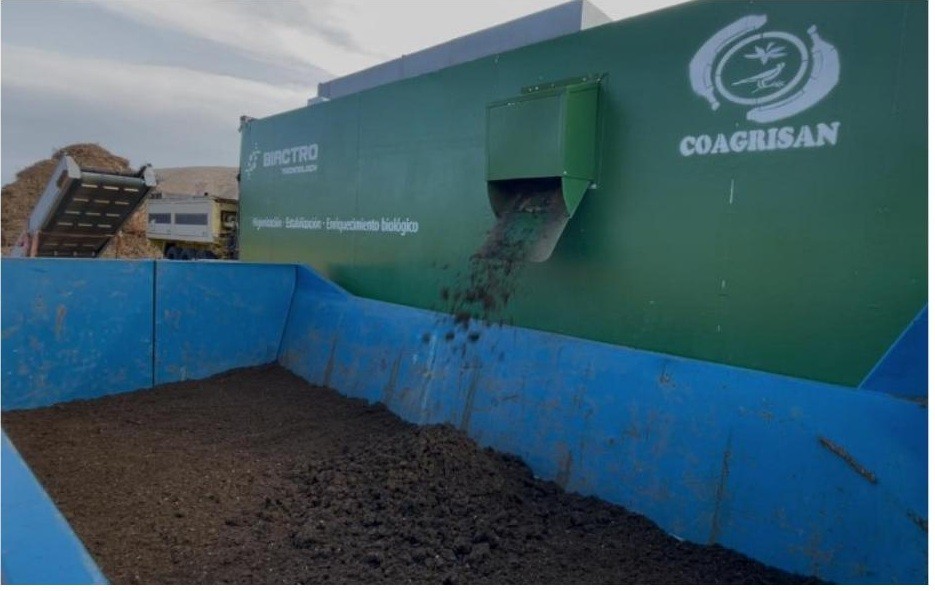
Enriched organic soil improver
On existing soil. The microbiota reactivates the biological life of the land and the stabilised organic matter restores structure, porosity and water-holding capacity. By composition and purity it belongs to the upper segment of the market.
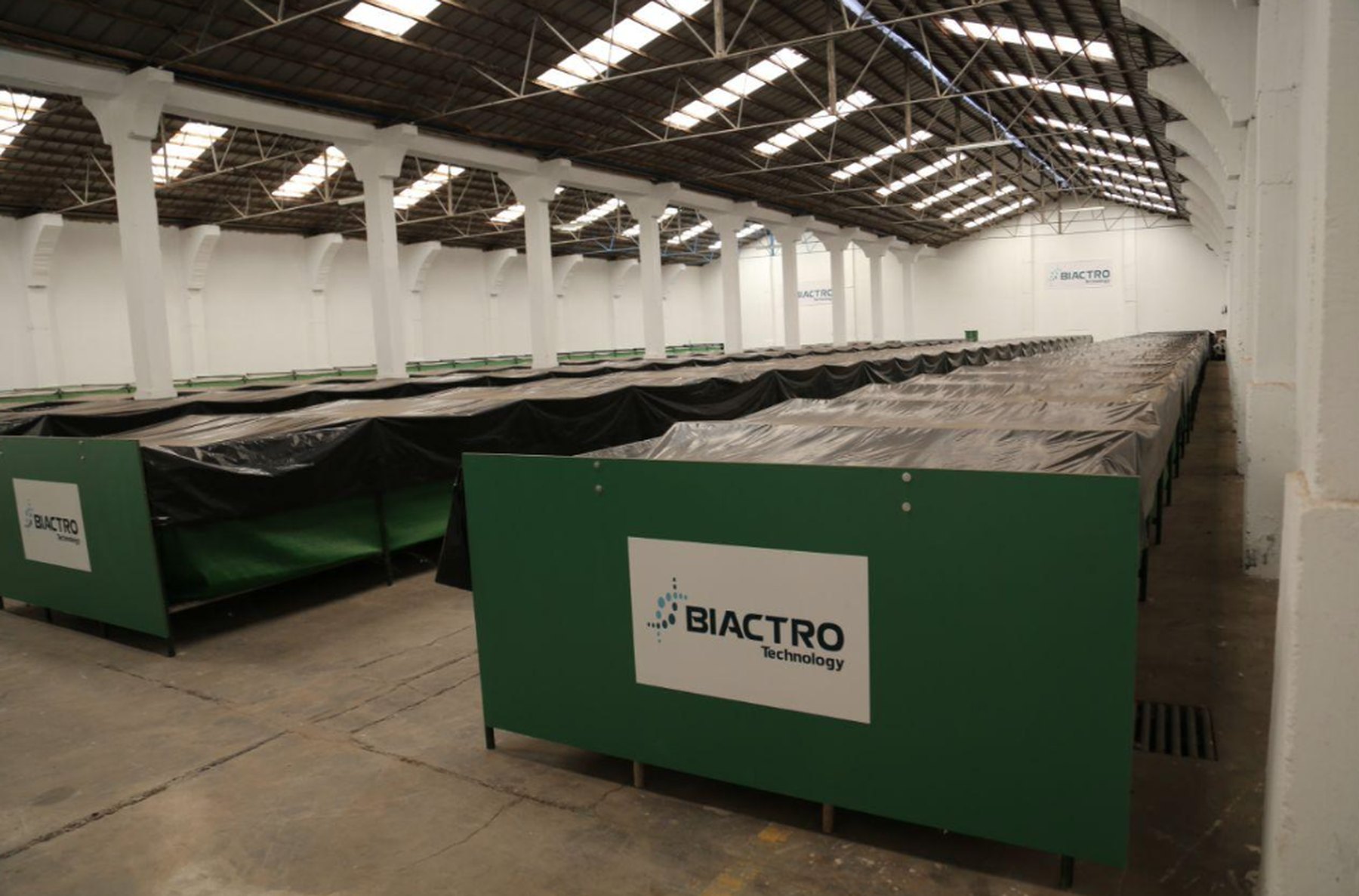
New growing soil
With nothing beneath. The material sustains the crop on its own in technical beds that use it as the sole substrate. The documented irrigation saving stands at between 50% and 60%, with yields maintained or improved.
A territory that uses this technology can manufacture the fertile soil it lacks, from what it discards today.
The transformation, measured.
Two samples from the same batch, one taken at the inlet and one at the outlet, analysed by a laboratory accredited to ISO/IEC 17025:2017.
Enters fermenting, comes out mature
The Rotegrade test measures the maturity of a material by its own heat: matter still decomposing heats up on its own. The incoming waste reaches 58.3 °C, the temperature of a mass in full fermentation, and the outgoing product stays below 10 °C, that of the surrounding air. It has stopped decomposing, and everything else follows from that: no methane, no leachate, no smell and no pests.
It stops being saline
Electrical conductivity measures dissolved salt concentration and falls from 24.3 to 4.0 dS/m. The incoming waste would burn the roots of any crop; the outgoing product falls within the range fit for direct application to soil, even on sensitive crops. For territories losing land to salinisation, that figure means bringing back into production land that is currently out of use.
The most valuable fraction triples
Humic acid rises from 2.2% to 6.0%, the most stable and durable fraction of organic matter. The detail is in how it happens: total humic extract holds at around 16% while fulvic acid falls from 13.9% to 9.5%. The quantity of humic substances does not increase, their quality improves. And total nitrogen rises from 1.39% to 2.40%.
Absence of pathogens that holds over time
What matters is that the absence of pathogens should last, and it does because of the maturity of the material. Immature matter retains a labile organic fraction, meaning readily available food: moisture and a little warmth are enough for bacteria to multiply on it again. In fully matured material that fraction is already consumed and the microbial community is in balance, so an unwanted bacterium arriving later finds neither substrate to feed on nor space to occupy. The absence ceases to be a snapshot of a single day and becomes a property of the product.
Analyses from July 2026 on untreated waste and treated product from the same batch. Full reports available on request.
Institutional backing.
Two grants totalling €1,620,000 awarded to Coagrisan for the industrial deployment of the technology.
The site for the plant at La Aldea de San Nicolás provided by the island authority.
An institutional report from Coagrisan signed by its general management in June 2026, with express authorisation for use before third parties.
Organic soil improver classified as Class A under Spanish Royal Decree 506/2013 on the basis of its heavy metal content, the most stringent category in the Spanish framework.
The system operates under Regulation (EU) 2019/1009 on fertilising products, Spanish Law 7/2022 on waste and contaminated soils for a circular economy, and Royal Decree 1051/2022 on sustainable nutrition in agricultural soils.
Media coverage
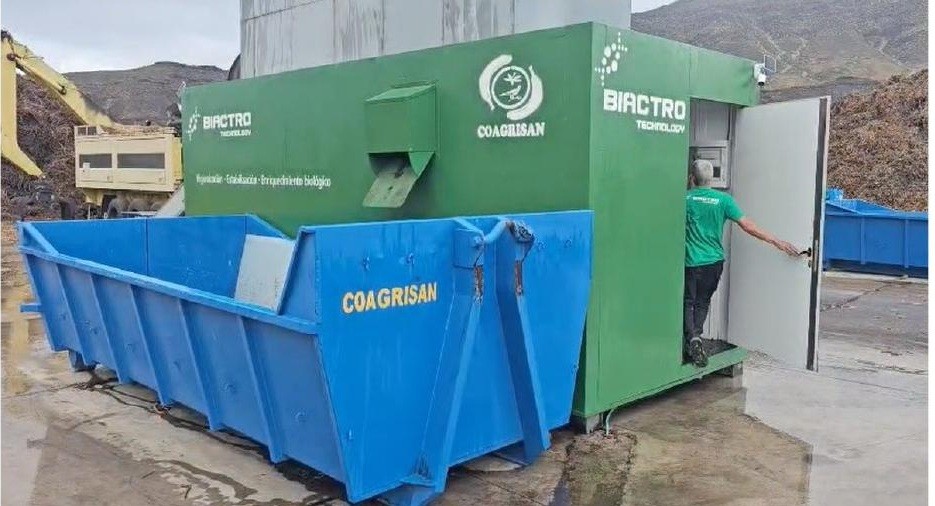 Radio Televisión Canaria
Canarian technology turning waste into Class A organic soil improver
Radio Televisión Canaria
Canarian technology turning waste into Class A organic soil improver
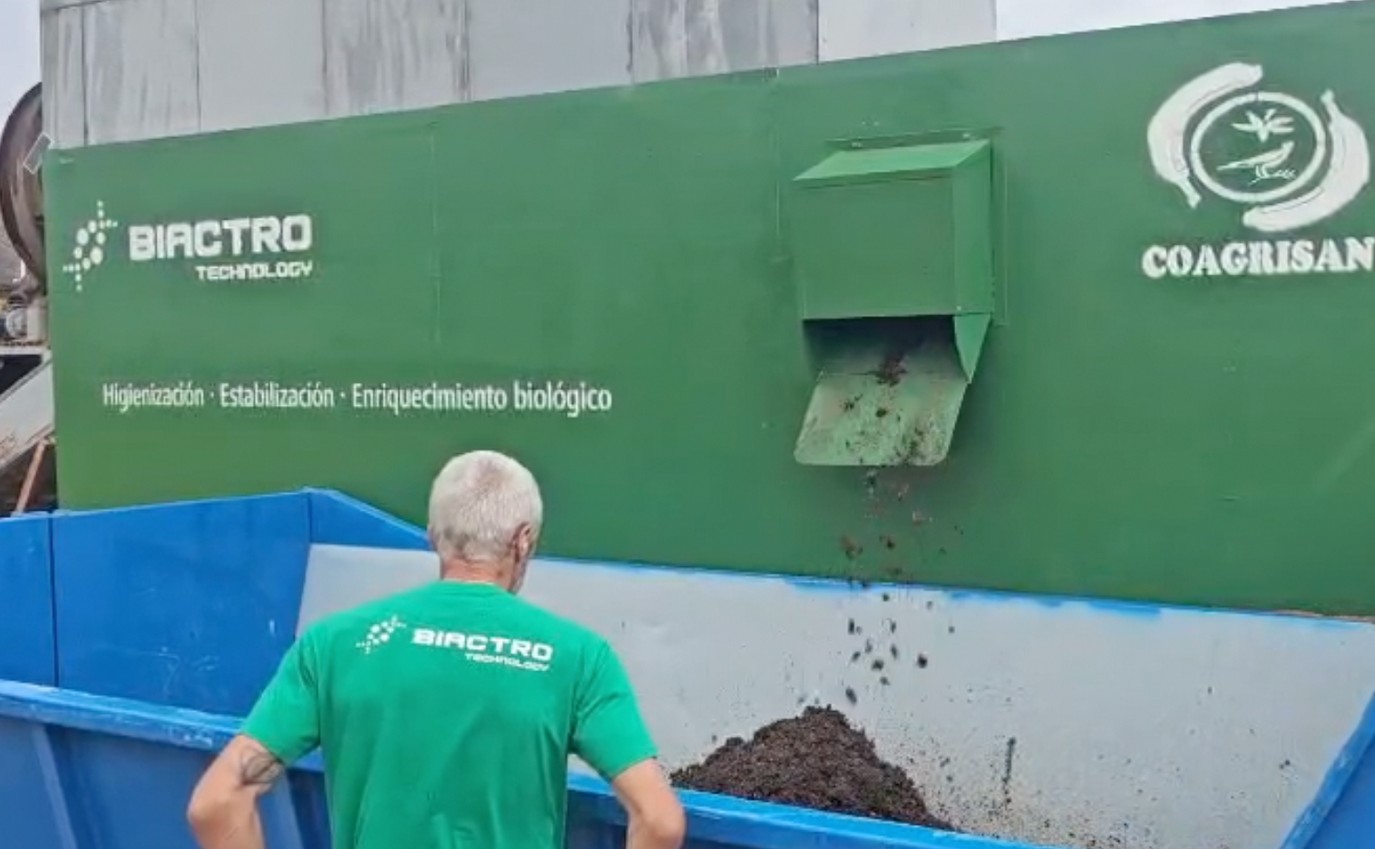 Televisión Española · TVE1
The system that processes organic waste at ambient temperature
Televisión Española · TVE1
The system that processes organic waste at ambient temperature
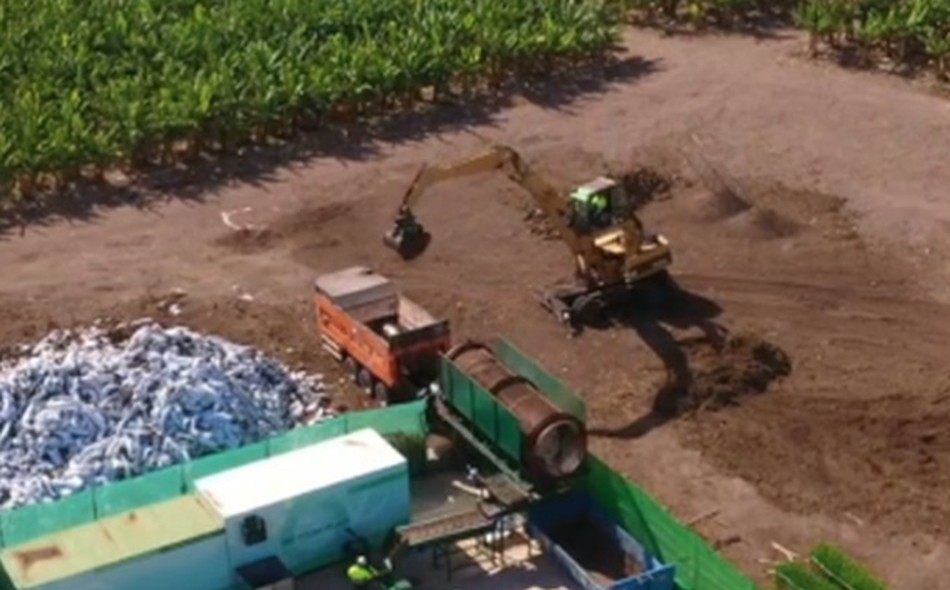
La Aldea, seven years running.
Coagrisan, the largest tomato-producing cooperative in the Canary Islands, generates some 7,000 tonnes of organic waste a year and for decades had nowhere to put them. The plant has operated there without interruption since 2019: waste arrives from the farms of the valley and returns to them as soil improver.
The cooperative documents harvest brought forward by seven to ten days in tomato and by two to three weeks in banana, holdings converted to certified organic production, and an installation without odours close to inhabited areas, with no neighbour complaint. Every kind of organic waste has also been trialled, alongside agronomic field tests.
The technology is fully developed. The hard part is already done.
Every territory is a different case.
The volume, its composition, its seasonality, the local regulatory framework and the destination of the product determine how each facility is configured and what form the collaboration takes.
You generate organic waste
- Cooperative, farm or livestock holding
- Food or processing industry
- Waste operator or biogas plant
- Authority responsible for the organic fraction
Request a Preliminary Technical Study.
You want to develop a project
- Industrial partner or investor
- Commercial channel in a specific territory
- Distributor of agricultural inputs
Each project is developed alongside local partners contributing operation, capital or commercial channel.
Get in touch.
- CompanyBiactro Technology S.L.
Calle Fresno 40, 35200 Telde, Gran Canaria - Emailinfo@biactro.com
- Phone+34 611 679 951
- WhatsAppChat on WhatsApp
- DocumentationAnalytical reports and institutional endorsement, on request.
- DossierDownload the dossier (PDF)